What is accuracy? The International Electrotechnical Commission’s (IEC) definition of accuracy is the maximum positive and negative deviation from the specified characteristic curve observed in testing a device under specified conditions and by a specified procedure. Unfortunately when it comes to defining accuracy for a pressure sensor it’s more complicated. Accuracy has a large effect on the cost of a pressure sensor or even more important, the quality or efficiency of the process it is measuring. It is important to understand what factors determine accuracy and what questions to ask when selecting a sensor.
Even though there isn’t a defined standard for pressure sensor accuracy there is an IEC standard that defines factors that make-up accuracy. IEC 61298-2 states that accuracy must include Hysteresis, Non-Repeatability and Non-Linearity. Non-Repeatability and Hysteresis are well defined. Hysteresis is the maximum difference in sensor output at a pressure when that pressure is first approached with pressure increasing and then approached with pressure decreasing during a full span pressure cycle. Non-Repeatability is the maximum difference in output when the same pressure is applied, consecutively, under the same conditions and approaching from the same direction.
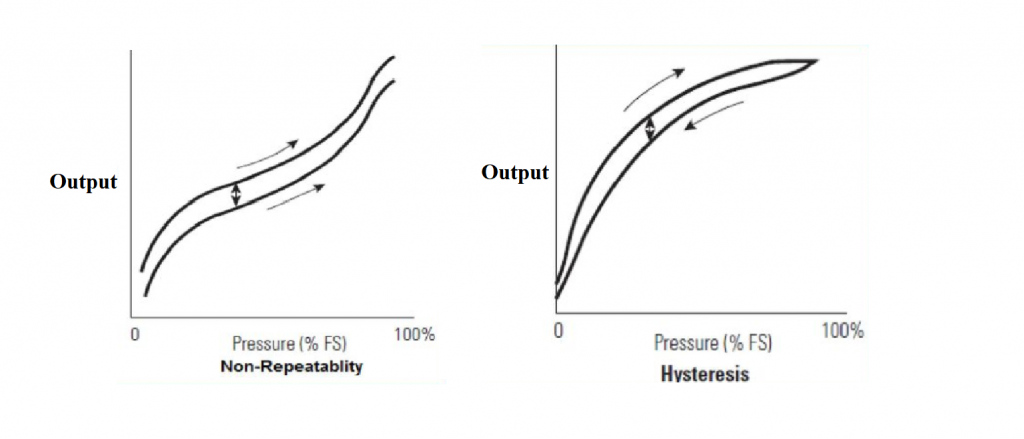
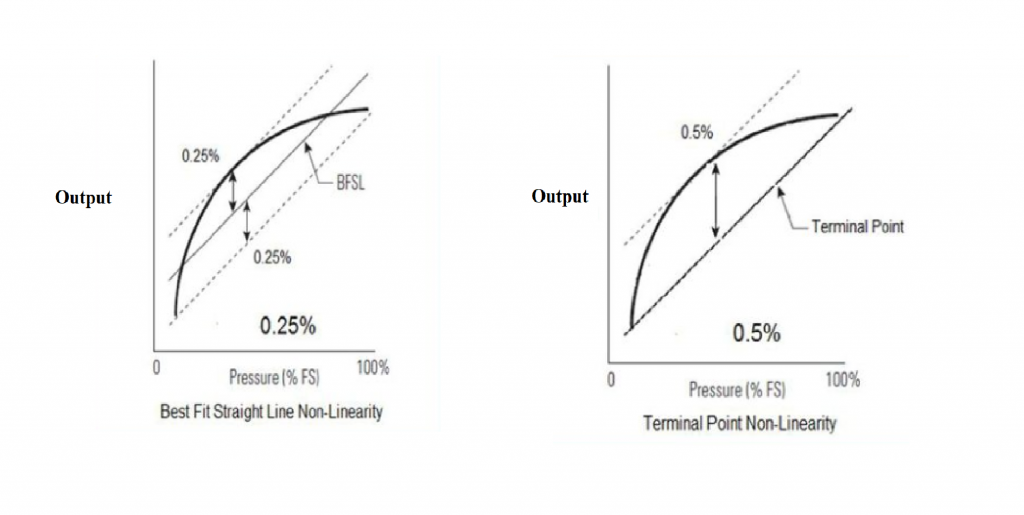
Where manufactures start to differentiate is with Non-Linearity. IEC 61298-2 lists three methods of Non-Linearity, the two most popular methods used by sensor manufactures are the Best Fit Straight Line (BFLS) Non-Linearity and Terminal Point Non-Linearity. Usually the method of non-linearity used will be specified with the sensors accuracy as BFSL or Terminal Point Method. Why is it important to understand the difference between these two methods? Based on the Non-Linearity characteristics of a sensor, it could have two vastly different Non-Linearity percentages. The following diagram shows how the same sensor can have two Non-linearity percentages.
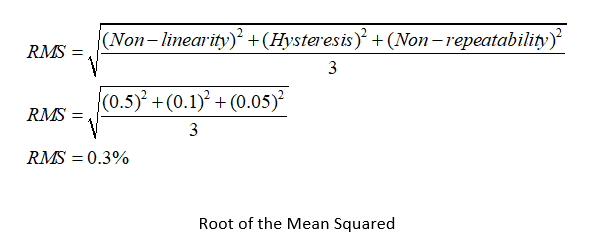
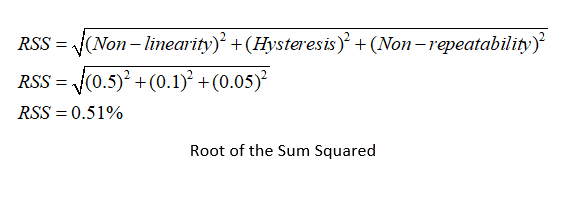
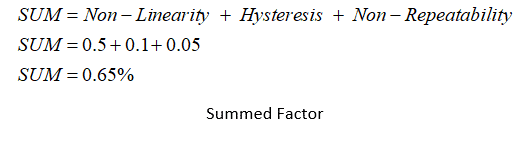
IEC 61298-2 identifies which factors make up accuracy (Non-Linearity, Non-Repeatability, and Hysteresis) but the IEC standard does not specify how these factors are combined into a single accuracy. The methods in which the values are combined have a substantial impact on the total accuracy. Some manufactures simply sum the three factors while others use mathematical equations such as Root of the Sum Squared or Root of the Mean Squared to combine Non-Linearity, Non-Repeatability, and Hysteresis into a total accuracy percentage. The following examples show how the same transmitter can have three accuracy percentages depending on which equation is used.
Non-Linearity – 0.5% BFSL
Non-Repeatability – 0.05% F.S.
Hysteresis – 0.1% F.S.
So why is this important? Accuracy has a price. The cost of a pressure sensor is a function of its accuracy, the more accurate the sensor the more expensive it will be. From a manufacturing point of view, the wrong sensors can cause expensive quality or efficiency problems. That is why it is important to understand how manufactures calculate accuracy and recognize what parameters to look at when comparing pressure sensors. By understanding how manufactures calculate accuracy, you will be able to make a more informed decision when evaluating pressure sensors. Ensuring the next sensor you select will have the required accuracy at right price for application.
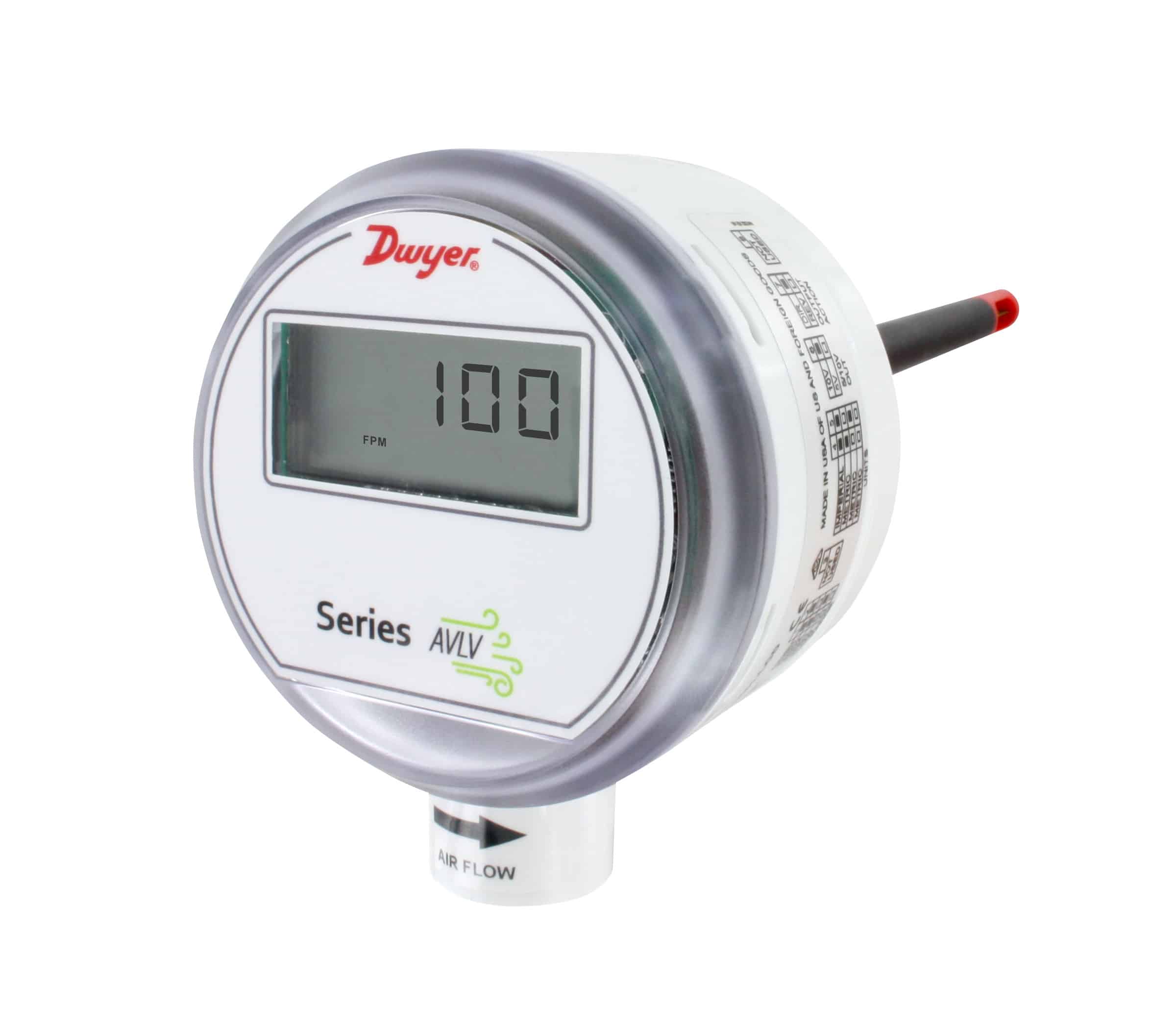
Dwyer Instruments offers a multitude of sensors for monitoring air velocity in HVAC systems. Some of this instrumentation has a simple construction (Pitot tubes, for example) while others are more complex, such as hot-wire anemometers. The initial term and first “hot-wire anemometer” was developed back in 1914 by Louie Vesso King. He is also accredited...
Explore now
From dairy to petrochemicals, several applications require monitoring or control of liquids in tanks. Wastewater facilities are among the many industries requiring meticulous observation. The technology used for this measurement is dependent upon the type of tank and its contents. Capacitive level switches, for example, detect level and send a switch signal output when the...
Explore now

 The Modular AHU (VAC series) is engineered to serve environments with stringent requirements for air quality, temperature, and humidity control. Thanks to its flexible modular design, cross-contamination prevention, microbial growth inhibition, and superior thermal insulation performance, the product is ideal for a wide range of diverse applications.
VECK - MODULAR AIR HANDLING UNIT (AHU) - VAC
Explore now
The Modular AHU (VAC series) is engineered to serve environments with stringent requirements for air quality, temperature, and humidity control. Thanks to its flexible modular design, cross-contamination prevention, microbial growth inhibition, and superior thermal insulation performance, the product is ideal for a wide range of diverse applications.
VECK - MODULAR AIR HANDLING UNIT (AHU) - VAC
Explore now
 The VECK VASW Series is a premier air-cooled screw chiller solution, specifically engineered for large-scale central air conditioning systems. By perfectly integrating advanced screw compressor technology with an intelligent control system, VECK is committed to delivering superior cooling efficiency across all weather conditions.
VECK - AIR-COOLED SCREW CHILLER - VASW
Explore now
The VECK VASW Series is a premier air-cooled screw chiller solution, specifically engineered for large-scale central air conditioning systems. By perfectly integrating advanced screw compressor technology with an intelligent control system, VECK is committed to delivering superior cooling efficiency across all weather conditions.
VECK - AIR-COOLED SCREW CHILLER - VASW
Explore now
 The VECK FCU Series is a premium line of Fan Coil Units featuring cutting-edge BLDC motor technology from China. Designed as an optimal solution, it delivers refreshing airflow, ultra-quiet operation, and exceptional energy efficiency. It is the perfect choice for central air conditioning systems in office buildings, hotels, and modern commercial projects.
VECK - FAN COIL UNIT (FCU)
Explore now
The VECK FCU Series is a premium line of Fan Coil Units featuring cutting-edge BLDC motor technology from China. Designed as an optimal solution, it delivers refreshing airflow, ultra-quiet operation, and exceptional energy efficiency. It is the perfect choice for central air conditioning systems in office buildings, hotels, and modern commercial projects.
VECK - FAN COIL UNIT (FCU)
Explore now
 The Ebara RHSCW Series is a water-cooled screw chiller line featuring Japan's leading twin-screw compression technology. It is an optimal solution designed to provide a stable chilled water supply for central air-conditioning systems and large-scale industrial cooling processes.
EBARA-HIGH EFFICIENCY SCREW CHILLER-RHSCW
Explore now
The Ebara RHSCW Series is a water-cooled screw chiller line featuring Japan's leading twin-screw compression technology. It is an optimal solution designed to provide a stable chilled water supply for central air-conditioning systems and large-scale industrial cooling processes.
EBARA-HIGH EFFICIENCY SCREW CHILLER-RHSCW
Explore now