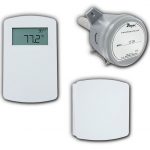
Dwyer offers several carbon dioxide measuring products that use non-dispersive infrared sensors as the sensing element. Carbon dioxide sensors are commonly used in building automation systems to monitor air quality. The level of carbon dioxide is indirectly proportional to the amount of people in a space and can be used to adjust ventilation for the space.
There are two basic types of gas sensing technologies: chemical reaction and infrared spectroscopic. Most chemical reaction sensors are electrochemical sensors, which are not as reliable as they can interact with multiple gases and wear from interaction with the gas.
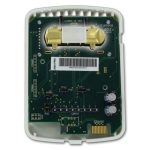
Non-dispersive infrared, often called NDIR, sensors deliver high accuracy and fast response time. NDIR sensors have no contact with the gas, making them more reliable, and are constructed for specific gases so that they are unaffected by other gases. NDIR sensors are the most reliable method for detecting carbon dioxide gas.
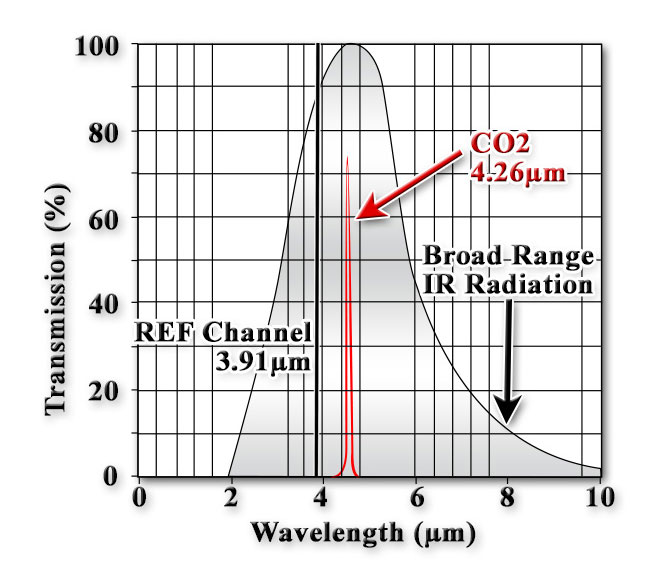
NDIR sensors are based on infrared spectroscopy, the principal that molecules absorb specific light frequencies that are characteristic of their structure. When the frequency of the infrared light is the same as the vibration frequency of a bond, absorption occurs. Infrared light absorption of a particular frequency or wavelength creates a signature for conclusive identification and analysis of the gas and concentration level.
A basic NDIR sensor consists of an infrared light source, a sample chamber, an infrared filter, and infrared detector. For carbon dioxide sensing, room or duct air is allowed to flow in and out of the sample chamber. Infrared light waves are created by the source and sent through the sample chamber to the detector. As the infrared light passes through the air in the chamber, light of a particular wavelength will be absorbed by the carbon dioxide molecules.
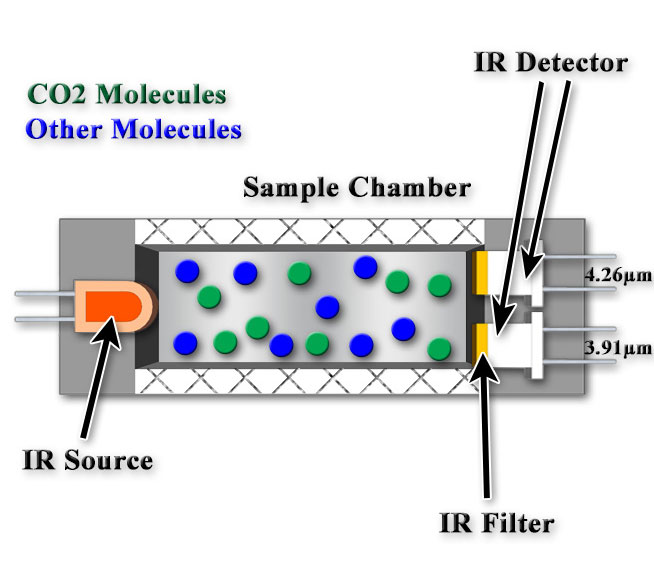
Infrared light that makes it through the chamber and filter in the carbon dioxide absorption wavelength is then sensed by the detector. The difference between the light emitted by the source and the light sensed by the detector for the carbon dioxide infrared wavelength is used to calculate the gas concentration since the amount of light absorbed is directly proportional to the gas concentration.
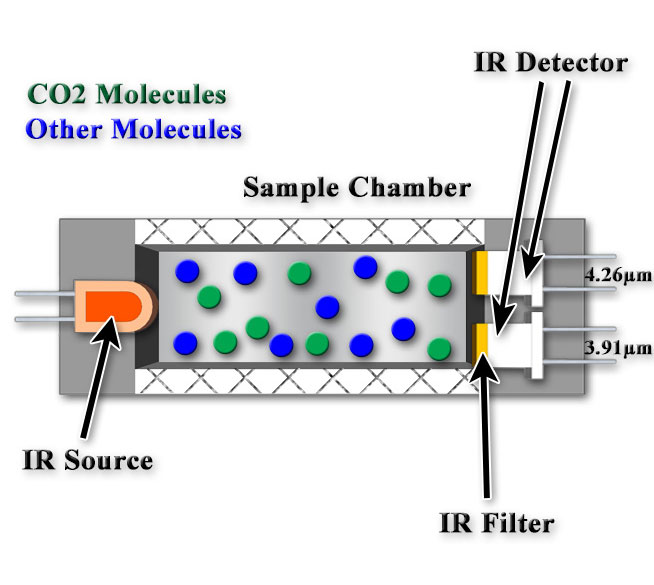
The level of infrared light that the detector receives plays an important role in sensor drift and measurement accuracy. The infrared light source will have degradation of illumination over time from film buildup and age. Dual-wavelength sensors use a reference light wavelength that is unaffected by the sensed gas. As the infrared light source changes over time, the gas measurement can be compensated accordingly, eliminating sensor drift errors. Dwyer Series CDT, CDTR, and CDTA all have dual-wavelength sensor compensation.
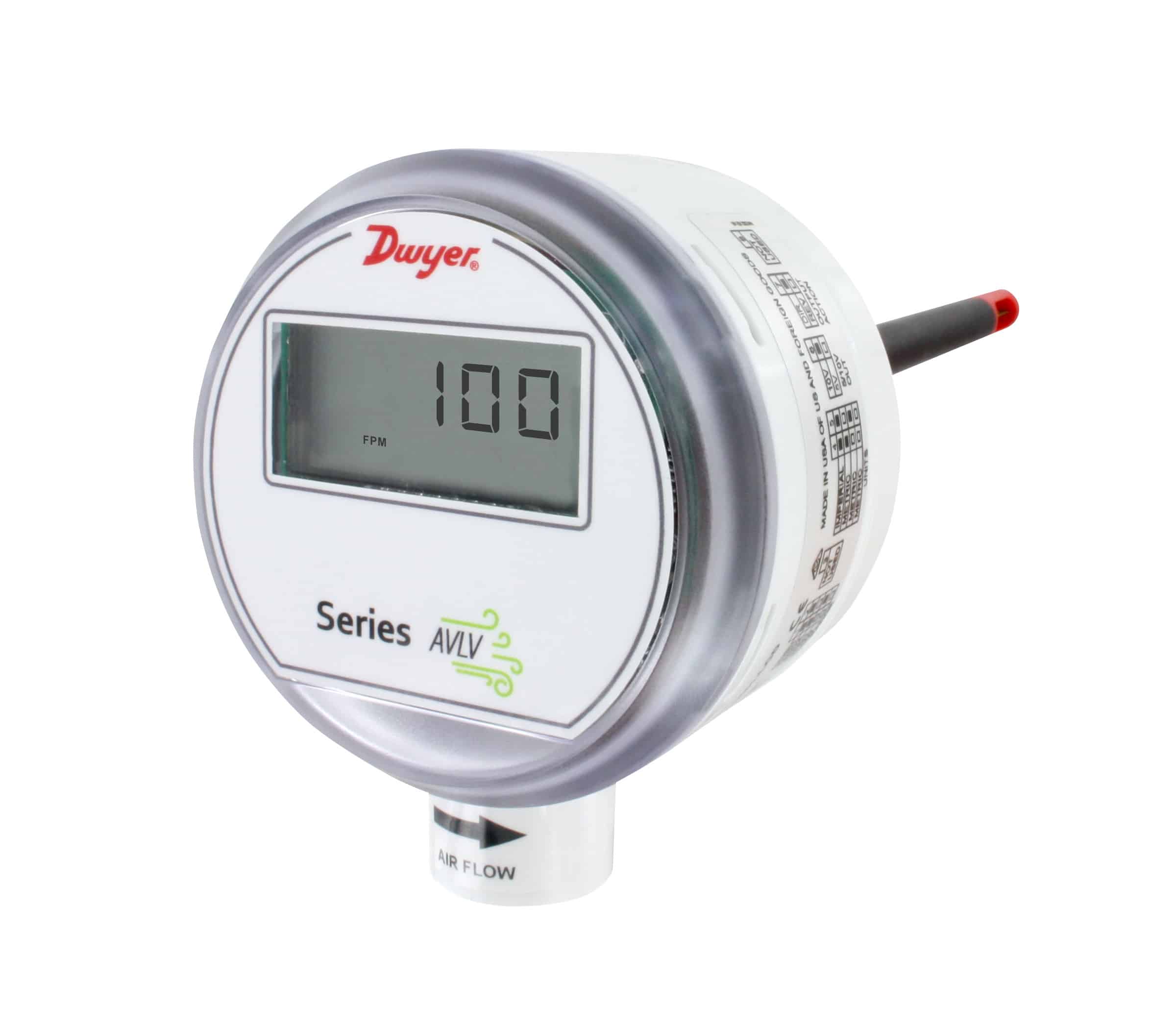
Dwyer Instruments offers a multitude of sensors for monitoring air velocity in HVAC systems. Some of this instrumentation has a simple construction (Pitot tubes, for example) while others are more complex, such as hot-wire anemometers. The initial term and first “hot-wire anemometer” was developed back in 1914 by Louie Vesso King. He is also accredited...
Explore now
From dairy to petrochemicals, several applications require monitoring or control of liquids in tanks. Wastewater facilities are among the many industries requiring meticulous observation. The technology used for this measurement is dependent upon the type of tank and its contents. Capacitive level switches, for example, detect level and send a switch signal output when the...
Explore now
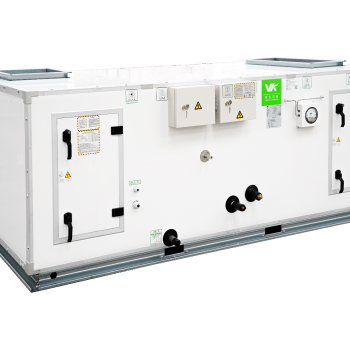 The Modular AHU (VAC series) is engineered to serve environments with stringent requirements for air quality, temperature, and humidity control. Thanks to its flexible modular design, cross-contamination prevention, microbial growth inhibition, and superior thermal insulation performance, the product is ideal for a wide range of diverse applications.
VECK - MODULAR AIR HANDLING UNIT (AHU) - VAC
Explore now
The Modular AHU (VAC series) is engineered to serve environments with stringent requirements for air quality, temperature, and humidity control. Thanks to its flexible modular design, cross-contamination prevention, microbial growth inhibition, and superior thermal insulation performance, the product is ideal for a wide range of diverse applications.
VECK - MODULAR AIR HANDLING UNIT (AHU) - VAC
Explore now
 The VECK VASW Series is a premier air-cooled screw chiller solution, specifically engineered for large-scale central air conditioning systems. By perfectly integrating advanced screw compressor technology with an intelligent control system, VECK is committed to delivering superior cooling efficiency across all weather conditions.
VECK - AIR-COOLED SCREW CHILLER - VASW
Explore now
The VECK VASW Series is a premier air-cooled screw chiller solution, specifically engineered for large-scale central air conditioning systems. By perfectly integrating advanced screw compressor technology with an intelligent control system, VECK is committed to delivering superior cooling efficiency across all weather conditions.
VECK - AIR-COOLED SCREW CHILLER - VASW
Explore now
 The VECK FCU Series is a premium line of Fan Coil Units featuring cutting-edge BLDC motor technology from China. Designed as an optimal solution, it delivers refreshing airflow, ultra-quiet operation, and exceptional energy efficiency. It is the perfect choice for central air conditioning systems in office buildings, hotels, and modern commercial projects.
VECK - FAN COIL UNIT (FCU)
Explore now
The VECK FCU Series is a premium line of Fan Coil Units featuring cutting-edge BLDC motor technology from China. Designed as an optimal solution, it delivers refreshing airflow, ultra-quiet operation, and exceptional energy efficiency. It is the perfect choice for central air conditioning systems in office buildings, hotels, and modern commercial projects.
VECK - FAN COIL UNIT (FCU)
Explore now
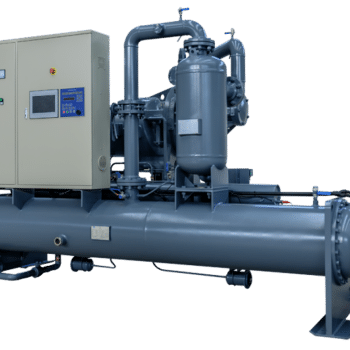 The Ebara RHSCW Series is a water-cooled screw chiller line featuring Japan's leading twin-screw compression technology. It is an optimal solution designed to provide a stable chilled water supply for central air-conditioning systems and large-scale industrial cooling processes.
EBARA-HIGH EFFICIENCY SCREW CHILLER-RHSCW
Explore now
The Ebara RHSCW Series is a water-cooled screw chiller line featuring Japan's leading twin-screw compression technology. It is an optimal solution designed to provide a stable chilled water supply for central air-conditioning systems and large-scale industrial cooling processes.
EBARA-HIGH EFFICIENCY SCREW CHILLER-RHSCW
Explore now