Are you having problems with your current lift station level controls? Dwyer Instruments may just have the cost effective solution you need. In this article we will review several level sensing strategies, the advantages and disadvantages of each, as well as an option you may want to consider for your next project.
Lift Station Basics
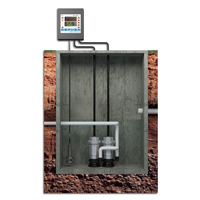
In an ideal gravity fed wastewater collection system, sewage would flow downhill from its point of origin in residential or commercial areas to its final treatment plant destination. Due to a number of factors including total distance, topography, geology, economics, etc., the ideal piping design is not always feasible. Therefore, in most cases, sewage flows downhill to a lift station where it collects and then is pumped to a higher elevation in order to begin its downhill journey again.
Lift stations are typically constructed of concrete or fiberglass and include: the pumps, rails, station cover, valve box, level sensor, and control panel. Regardless of the construction method that is selected, the level sensor is an extremely critical component, as it provides the feedback needed to determine when the pump turns on and off.
Float Controls
This is the most basic type of level sensing and control setup which is still widely used today. These systems essentially consist of a number of cable float level switches installed in the wet well and a float controller to initiate the motor starter relays. The number of floats required will vary based upon the number of pumps in the well and alarm points needed. Typically, one would need two switches per pump for the on and off points of each, as well as, one for a high alarm or possibly a low alarm. So in a common duplex system you would likely have at least five switches. To set your switch points one would either vary how far down the well they hang or install counter weights which act as the pivot points.
Advantages: Typically inexpensive depending on the number and types of floats and simple in operation.
Disadvantages: These systems do not provide any continuous feedback for the actual level in the well. The actuation points can be difficult to accurately set. As well, the floats can become entangled or coated with grease where they will not actuate; thus, creating unwanted service calls.
Bubbler Systems
The liquid level in a station is relative to the hydrostatic pressure measured at the bottom of the well. To measure this pressure a constant air volume can be pumped through a tube that exhausts at the bottom of the well. By measuring the pressure inside that tube you can determine the sewage level. Bubbler systems consist of a bubbler tube installed in the wet well, an air supply compressor, flowmeter, and a pressure switch or pressure transmitter.
Advantage: Relatively low initial cost; can be used for continuous monitoring or simple on/off control.
Disadvantage: Maintenance and total operating costs. These systems require periodic cleaning of the bubbler tube which can commonly become clogged and the mechanical air supplies will wear out and need replaced.
Continuous Monitoring
The municipal market is definitely trending towards more sophisticated control systems that can provide real-time information. With tightening environmental regulations this allows treatment to be more accurate and efficient, as well as, making system reporting and troubleshooting less time consuming. Continuous monitoring of the lift station level, particularly in larger more critical stations is becoming much more common for these reasons. These systems will typically consist of an analog sensor in the well that signals a stand alone control or PLC style controller to initiate the pump starts and stops. This information can then be fed into a network or RTU that would report back to a central plant or SCADA system.
Ultrasonic Transmitters
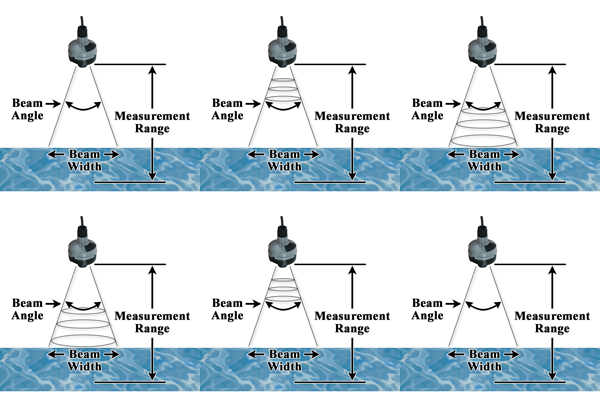
Ultrasonic level sensors provide a continuous analog output by bouncing sound waves off the surface of the water/sewage. This is a non-contact measurement so the sensor would be mounted somewhere at the top of the well and typically have a signal conversion device or controller mounted back at the panel.
Advantages: Non-contact measurement, scalable output flexibility.
Disadvantages: Ultrasonic level sensors are typically a more expensive option and require more care in their installation to ensure there are no obstructions (i.e. pipes, cables, walls, rails, etc.) within the cone angle that would impede the sound wave travel. In many lift stations there just isn’t a good place to mount the sensor and avoid these obstructions. Next, there is more time involved in the initial setup as their outputs typically need calibrated for every station based on where the sensor is mounted. Foam and condensation are also issues for this technology; as foam will produce false level readings and condensation on the sensor head, can eliminate the signal altogether. Lastly, most of these sensors are not designed to be submerged so flooded stations would ruin the sensors.
Submersible Level Transmitters
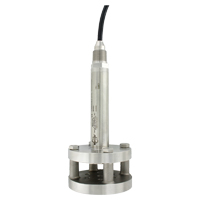
Dwyer provides options for all of the previously stated strategies; but, in a majority ofapplications recommend one of our submersible level transmitters like the Series PBLT2 & PBLTX, SBLT2 & SBLTX, MBLT, and FBLT. Again, by measuring the hydrostatic pressure from the bottom of the wet well you can determine the liquid level, rather than measuring the pressure through a bubbler tube, with submersible level transmitters. One can put the pressure sensor at the reference point by dropping it directly into the sewage. These will then provide a continuous, typically 4-20 mA, analog signal output relative to a fixed level range. A built in breather tube allows the sensor to automatically compensate for changes in barometric pressure.
Advantages: Very cost competitive up front and operationally. Submersibles are also easy to setup and install…simply drop it in and hook up your two wires. There are NO floats to get tangled, NO tube to get clogged or compressors to replace, and there are NO issues with foam or condensation!
Disadvantages: Some designs require periodic cleaning. However with the newer, large sensing diaphragm type like the Dwyer PBLT2, clogging risks are essentially eliminated.
Dwyer Instruments offers a multitude of sensors for monitoring air velocity in HVAC systems. Some of this instrumentation has a simple construction (Pitot tubes, for example) while others are more complex, such as hot-wire anemometers. The initial term and first “hot-wire anemometer” was developed back in 1914 by Louie Vesso King. He is also accredited...
Explore now
From dairy to petrochemicals, several applications require monitoring or control of liquids in tanks. Wastewater facilities are among the many industries requiring meticulous observation. The technology used for this measurement is dependent upon the type of tank and its contents. Capacitive level switches, for example, detect level and send a switch signal output when the...
Explore now
 The Modular AHU (VAC series) is engineered to serve environments with stringent requirements for air quality, temperature, and humidity control. Thanks to its flexible modular design, cross-contamination prevention, microbial growth inhibition, and superior thermal insulation performance, the product is ideal for a wide range of diverse applications.
VECK - MODULAR AIR HANDLING UNIT (AHU) - VAC
Explore now
The Modular AHU (VAC series) is engineered to serve environments with stringent requirements for air quality, temperature, and humidity control. Thanks to its flexible modular design, cross-contamination prevention, microbial growth inhibition, and superior thermal insulation performance, the product is ideal for a wide range of diverse applications.
VECK - MODULAR AIR HANDLING UNIT (AHU) - VAC
Explore now
 The VECK VASW Series is a premier air-cooled screw chiller solution, specifically engineered for large-scale central air conditioning systems. By perfectly integrating advanced screw compressor technology with an intelligent control system, VECK is committed to delivering superior cooling efficiency across all weather conditions.
VECK - AIR-COOLED SCREW CHILLER - VASW
Explore now
The VECK VASW Series is a premier air-cooled screw chiller solution, specifically engineered for large-scale central air conditioning systems. By perfectly integrating advanced screw compressor technology with an intelligent control system, VECK is committed to delivering superior cooling efficiency across all weather conditions.
VECK - AIR-COOLED SCREW CHILLER - VASW
Explore now
 The VECK FCU Series is a premium line of Fan Coil Units featuring cutting-edge BLDC motor technology from China. Designed as an optimal solution, it delivers refreshing airflow, ultra-quiet operation, and exceptional energy efficiency. It is the perfect choice for central air conditioning systems in office buildings, hotels, and modern commercial projects.
VECK - FAN COIL UNIT (FCU)
Explore now
The VECK FCU Series is a premium line of Fan Coil Units featuring cutting-edge BLDC motor technology from China. Designed as an optimal solution, it delivers refreshing airflow, ultra-quiet operation, and exceptional energy efficiency. It is the perfect choice for central air conditioning systems in office buildings, hotels, and modern commercial projects.
VECK - FAN COIL UNIT (FCU)
Explore now
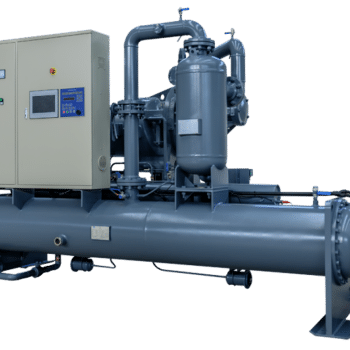 The Ebara RHSCW Series is a water-cooled screw chiller line featuring Japan's leading twin-screw compression technology. It is an optimal solution designed to provide a stable chilled water supply for central air-conditioning systems and large-scale industrial cooling processes.
EBARA-HIGH EFFICIENCY SCREW CHILLER-RHSCW
Explore now
The Ebara RHSCW Series is a water-cooled screw chiller line featuring Japan's leading twin-screw compression technology. It is an optimal solution designed to provide a stable chilled water supply for central air-conditioning systems and large-scale industrial cooling processes.
EBARA-HIGH EFFICIENCY SCREW CHILLER-RHSCW
Explore now