
The purpose of a clean room is to limit the number of particulates in a clean space. These particulates can be any type of sub-micron particles, such as dust, pathogens, chemical vapors, or moisture droplets. Clean room manufacturing areas are used by many industries to produce semiconductors, pharmaceuticals, medical devices, etc.
Maintaining a proper differential pressure between the clean room and the exterior area is the most crucial aspect of keeping the clean room “clean”. To understand why sensor stability is important to these critical applications, it is important to also understand why a pressure difference is needed.
A pressure difference between a clean room and the anteroom, or the room immediately outside the clean room, is needed to ensure low to no infiltration of unwanted particulate matter into the clean room.
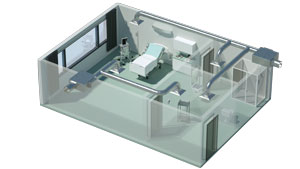
If a clean room is kept at a positive pressure in relation to the anteroom, it will force all air (and particulate matter) out to the anteroom. If you have ever walked into a building and noticed a draft coming from inside the building to the outside while blowing the door open, you have experienced a building under positive pressure in relation to the outside. In this case, the door was likely difficult to close because of the high-pressure differential.
Clean rooms operate under the same conditions, but typically at a much lower differential pressure between the anteroom and the clean room (around 0.02-0.05” w.c. depending on the level of the clean room). This small pressure difference between the rooms is enough to keep out all the unwanted particulates.
Positive pressure in clean rooms is maintained by a fan, or blower, typically within a VAV (variable air volume) system that increases the amount of air provided into the clean room. The more air provided into the room, the higher the air pressure in it.
A differential pressure sensor, like a room pressure monitor, room status monitor, or a simple differential pressure transmitter, measures the pressure difference between the cleanroom and anteroom. It then provides the measurement to a DDC (direct digital controller) that controls the VAV system. If the pressure is too low, the VAV system will provide more air; if the pressure is too high, the VAV system will limit the amount of air it pumps into the room.

Since the pressure that is to be maintained is relatively narrow (0.02-0.05” w.c.), it is important that the differential pressure sensors maintain their accuracy over time. In other words, the sensors need to have excellent stability.
If stability is not maintained and the pressure sensor drifts, becoming inaccurate over time, the VAV system will either provide too much or too little air. As a result, the positive pressure of the clean room can be compromised. Particulates will then be able to enter the clean room and damage or destroy the goods being manufactured in that clean environment.
Depending on the type of clean room and specific application, other environmental parameters besides differential pressure will also likely need to be maintained. Additional parameters could include:
Using sensors with high stability will help to ensure clean rooms meet quality and safety standards. Stability will help ensure that safe levels for all clean room applications, including pharmaceutical, semiconductor, and medical device manufacturing, are maintained.
To learn more about stability and why it is important, read our previous blog articles listed below:
Dwyer Instruments offers a multitude of sensors for monitoring air velocity in HVAC systems. Some of this instrumentation has a simple construction (Pitot tubes, for example) while others are more complex, such as hot-wire anemometers. The initial term and first “hot-wire anemometer” was developed back in 1914 by Louie Vesso King. He is also accredited...
Explore now
From dairy to petrochemicals, several applications require monitoring or control of liquids in tanks. Wastewater facilities are among the many industries requiring meticulous observation. The technology used for this measurement is dependent upon the type of tank and its contents. Capacitive level switches, for example, detect level and send a switch signal output when the...
Explore now
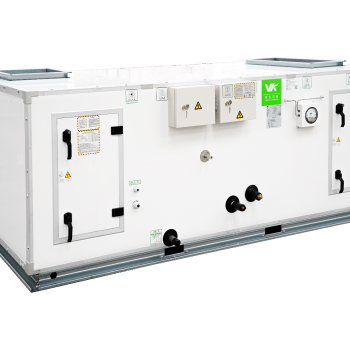 The Modular AHU (VAC series) is engineered to serve environments with stringent requirements for air quality, temperature, and humidity control. Thanks to its flexible modular design, cross-contamination prevention, microbial growth inhibition, and superior thermal insulation performance, the product is ideal for a wide range of diverse applications.
VECK - MODULAR AIR HANDLING UNIT (AHU) - VAC
Explore now
The Modular AHU (VAC series) is engineered to serve environments with stringent requirements for air quality, temperature, and humidity control. Thanks to its flexible modular design, cross-contamination prevention, microbial growth inhibition, and superior thermal insulation performance, the product is ideal for a wide range of diverse applications.
VECK - MODULAR AIR HANDLING UNIT (AHU) - VAC
Explore now
 The VECK VASW Series is a premier air-cooled screw chiller solution, specifically engineered for large-scale central air conditioning systems. By perfectly integrating advanced screw compressor technology with an intelligent control system, VECK is committed to delivering superior cooling efficiency across all weather conditions.
VECK - AIR-COOLED SCREW CHILLER - VASW
Explore now
The VECK VASW Series is a premier air-cooled screw chiller solution, specifically engineered for large-scale central air conditioning systems. By perfectly integrating advanced screw compressor technology with an intelligent control system, VECK is committed to delivering superior cooling efficiency across all weather conditions.
VECK - AIR-COOLED SCREW CHILLER - VASW
Explore now
 The VECK FCU Series is a premium line of Fan Coil Units featuring cutting-edge BLDC motor technology from China. Designed as an optimal solution, it delivers refreshing airflow, ultra-quiet operation, and exceptional energy efficiency. It is the perfect choice for central air conditioning systems in office buildings, hotels, and modern commercial projects.
VECK - FAN COIL UNIT (FCU)
Explore now
The VECK FCU Series is a premium line of Fan Coil Units featuring cutting-edge BLDC motor technology from China. Designed as an optimal solution, it delivers refreshing airflow, ultra-quiet operation, and exceptional energy efficiency. It is the perfect choice for central air conditioning systems in office buildings, hotels, and modern commercial projects.
VECK - FAN COIL UNIT (FCU)
Explore now
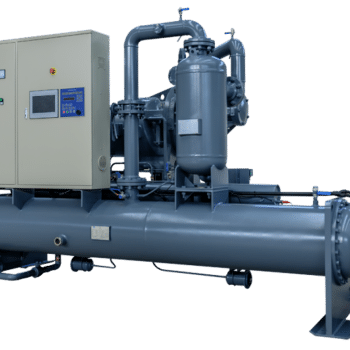 The Ebara RHSCW Series is a water-cooled screw chiller line featuring Japan's leading twin-screw compression technology. It is an optimal solution designed to provide a stable chilled water supply for central air-conditioning systems and large-scale industrial cooling processes.
EBARA-HIGH EFFICIENCY SCREW CHILLER-RHSCW
Explore now
The Ebara RHSCW Series is a water-cooled screw chiller line featuring Japan's leading twin-screw compression technology. It is an optimal solution designed to provide a stable chilled water supply for central air-conditioning systems and large-scale industrial cooling processes.
EBARA-HIGH EFFICIENCY SCREW CHILLER-RHSCW
Explore now