According to the Environmental Protection Agency (EPA), more than 280 million people get their drinking water from a community water system. Drinking water supplies in the United States are among the safest in the world, but even these water sources can become contaminated. Before fresh water can be considered potable, it must be treated to be made safe for drinking. Systems are set in place to ensure ongoing water quality, which then allows this treated water to be sent through water pipes and into our homes.

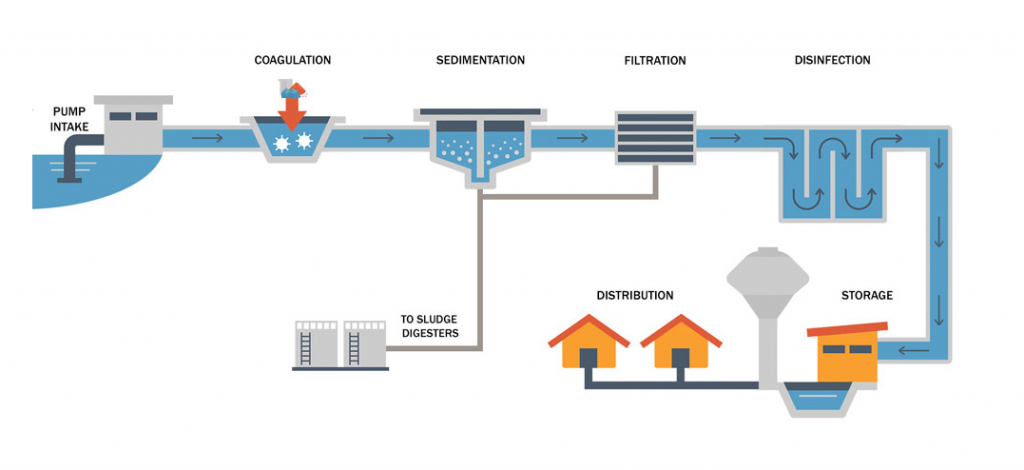
Water is pumped from a water source, such as a lake, river, or ground water, into the water purification plant via a pump station. As it enters the pump station, the water is sent through a screen. This helps prevent large debris (such as wood, fish, and plants) from entering the system and clogging equipment.

After water is pumped into the treatment plant, the purification process begins. Coagulant chemicals are added to the water and mixed at a high rate. The coagulation causes any fine particulates in the water to stick together, forming larger clumps of particles (known as floc).
3. Sedimentation

Following the coagulation process, the water and floc particles are sent into a sedimentation basin. During this time, the floc has the opportunity to settle to the bottom of the tank, where it can be removed; the clean water at the top of the tank is sent to be filtered.
4. Filtration

The filtration process allows water to pass through natural filters of variable sizes and compositions (e.g. sand, gravel, and charcoal). These natural filters help to sift out any remaining particles in the water.
Solid matter collected in the sedimentation and filtration processes is sent to be used as fertilizer.
5. Disinfection

To protect against bacteria, viruses, and other microbes, the water must be disinfected. In most cases, this is done using chemicals such as chlorine or with ultraviolet light.
6. Storage & Distribution

After the water purification process has been completed, the water is pumped into water storage tanks. The clean, safe drinking water is then pumped to homes and businesses when needed.
Water purification is a specialized and involved process that focuses on keeping communities healthy. These steps guarantee continuous access to safe drinking water.
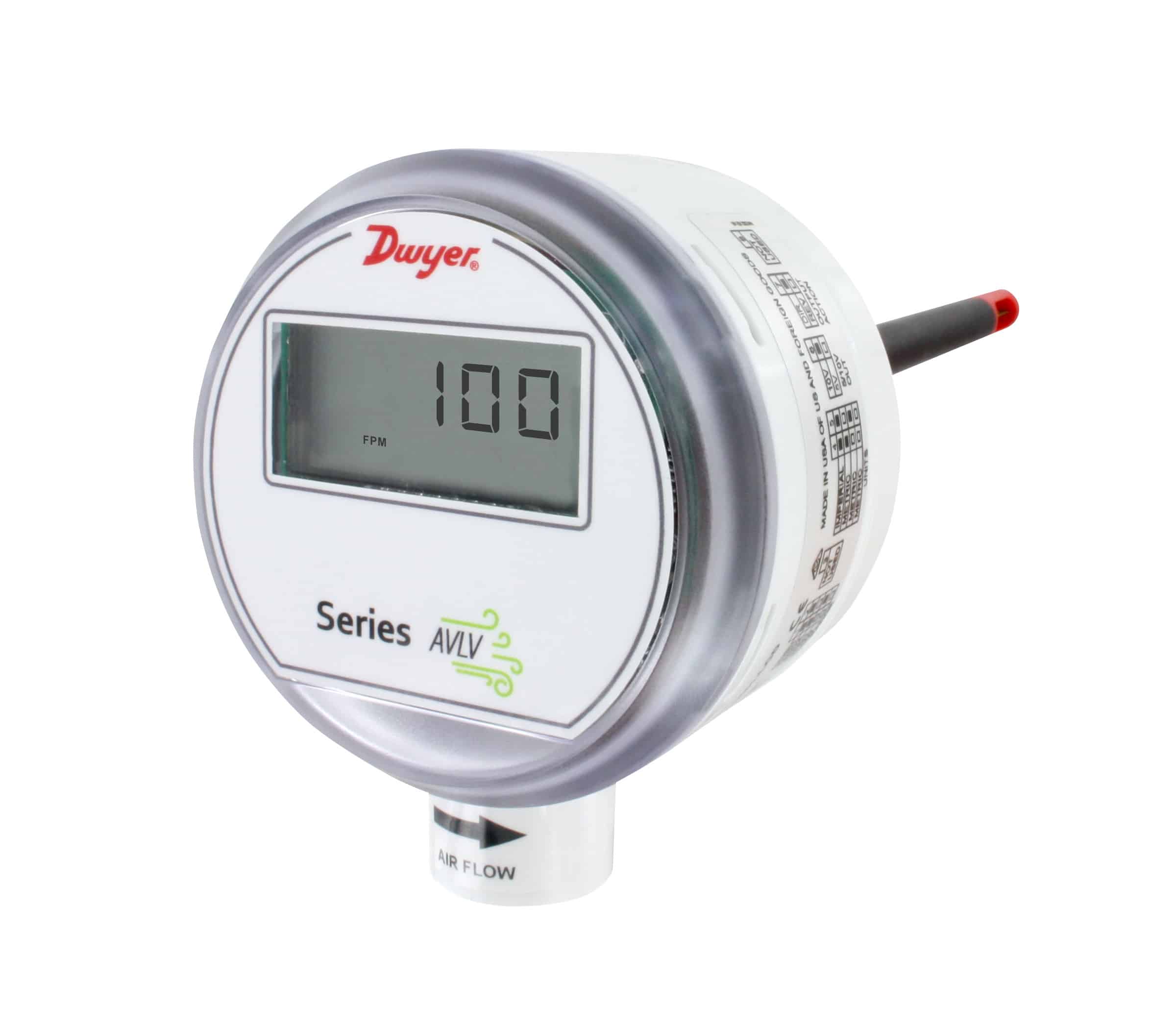
Dwyer Instruments offers a multitude of sensors for monitoring air velocity in HVAC systems. Some of this instrumentation has a simple construction (Pitot tubes, for example) while others are more complex, such as hot-wire anemometers. The initial term and first “hot-wire anemometer” was developed back in 1914 by Louie Vesso King. He is also accredited...
Explore now
From dairy to petrochemicals, several applications require monitoring or control of liquids in tanks. Wastewater facilities are among the many industries requiring meticulous observation. The technology used for this measurement is dependent upon the type of tank and its contents. Capacitive level switches, for example, detect level and send a switch signal output when the...
Explore now
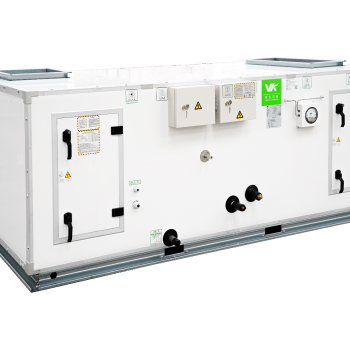 The Modular AHU (VAC series) is engineered to serve environments with stringent requirements for air quality, temperature, and humidity control. Thanks to its flexible modular design, cross-contamination prevention, microbial growth inhibition, and superior thermal insulation performance, the product is ideal for a wide range of diverse applications.
VECK - MODULAR AIR HANDLING UNIT (AHU) - VAC
Explore now
The Modular AHU (VAC series) is engineered to serve environments with stringent requirements for air quality, temperature, and humidity control. Thanks to its flexible modular design, cross-contamination prevention, microbial growth inhibition, and superior thermal insulation performance, the product is ideal for a wide range of diverse applications.
VECK - MODULAR AIR HANDLING UNIT (AHU) - VAC
Explore now
 The VECK VASW Series is a premier air-cooled screw chiller solution, specifically engineered for large-scale central air conditioning systems. By perfectly integrating advanced screw compressor technology with an intelligent control system, VECK is committed to delivering superior cooling efficiency across all weather conditions.
VECK - AIR-COOLED SCREW CHILLER - VASW
Explore now
The VECK VASW Series is a premier air-cooled screw chiller solution, specifically engineered for large-scale central air conditioning systems. By perfectly integrating advanced screw compressor technology with an intelligent control system, VECK is committed to delivering superior cooling efficiency across all weather conditions.
VECK - AIR-COOLED SCREW CHILLER - VASW
Explore now
 The VECK FCU Series is a premium line of Fan Coil Units featuring cutting-edge BLDC motor technology from China. Designed as an optimal solution, it delivers refreshing airflow, ultra-quiet operation, and exceptional energy efficiency. It is the perfect choice for central air conditioning systems in office buildings, hotels, and modern commercial projects.
VECK - FAN COIL UNIT (FCU)
Explore now
The VECK FCU Series is a premium line of Fan Coil Units featuring cutting-edge BLDC motor technology from China. Designed as an optimal solution, it delivers refreshing airflow, ultra-quiet operation, and exceptional energy efficiency. It is the perfect choice for central air conditioning systems in office buildings, hotels, and modern commercial projects.
VECK - FAN COIL UNIT (FCU)
Explore now
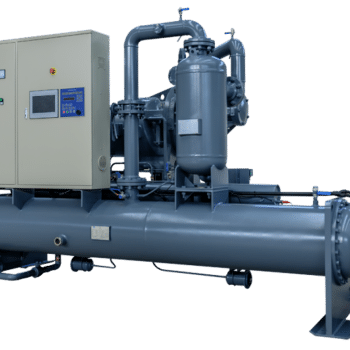 The Ebara RHSCW Series is a water-cooled screw chiller line featuring Japan's leading twin-screw compression technology. It is an optimal solution designed to provide a stable chilled water supply for central air-conditioning systems and large-scale industrial cooling processes.
EBARA-HIGH EFFICIENCY SCREW CHILLER-RHSCW
Explore now
The Ebara RHSCW Series is a water-cooled screw chiller line featuring Japan's leading twin-screw compression technology. It is an optimal solution designed to provide a stable chilled water supply for central air-conditioning systems and large-scale industrial cooling processes.
EBARA-HIGH EFFICIENCY SCREW CHILLER-RHSCW
Explore now