The crisp touch of a page, the smoothness of a glossy photograph. Despite using paper for so much throughout our lives, many do not know much about how paper is created besides the vague notion that it comes from trees. In fact, there are several steps for paper to transition from the forest into your hands.
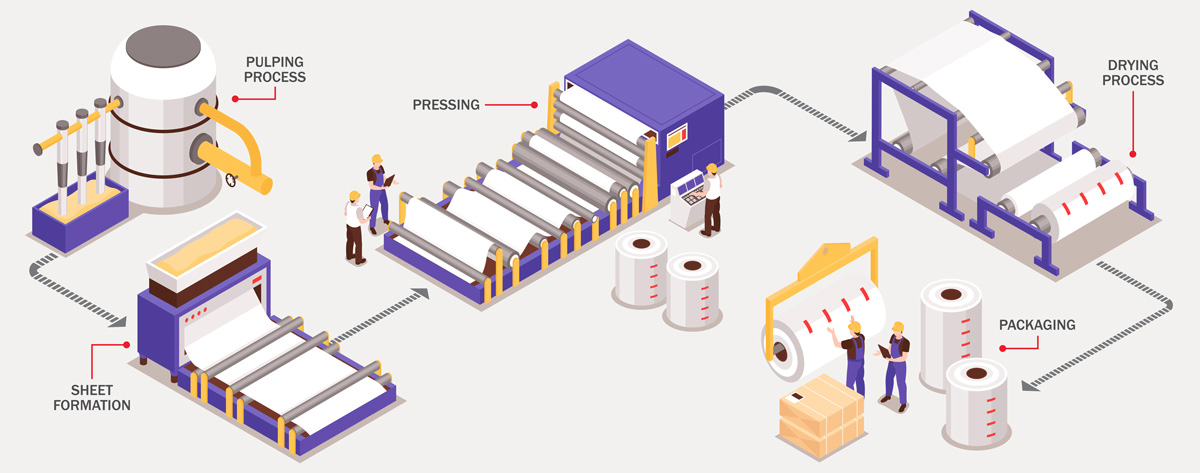
Chemical Pulping
When a bolt (or short section) of wood arrives at a pulp mill, it is first debarked by tumbling in steel drums. It then moves to a wood chipper and is screened for size before continuing onto the fiber separation stage. A single pine tree can produce approximately 80,500 sheets of paper. (HSW)
The chips are kept in a digester, where they are treated with the appropriate chemicals and steam in order to separate out the good fibers from the rest. This pulp is then sent to a pressure tank from which steam and volatile substances are removed. Chemical pulp is used for high quality papers.
Mechanical Pulping
The mechanical pulping process is similar to that of chemical pulping as both begin with chipping the wood. Instead of heading to a digester, the pulp in this process then heads to a refiner. Mechanical pulping can be broken into two categories: ground pulp and thermo-mechanical pulp. Both of these can be used for lower quality papers, such as newsprint.
Sheet Formation & Processing
Pulp contains a number of discolorants, and needs to be bleached in order to have the light color preferred for many paper products. The bleaching process varies depending upon the type and condition of pulp. The pulp may then be further refined by adding water to the slurry mixture, cleaning it in a cyclone cleaner, and screening it with centrifugal screens. The wet mixture is fed into a paper-forming machine where it is distributed evenly. It is pressed, dried, and wound onto large rolls for packaging and shipment.
Did you know? The U.S. Pulp and Paper Industry produces 78 million tons of paper per year!
Why Dwyer
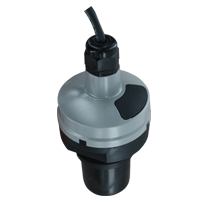
Dwyer Instruments, Inc. offers several product solutions for monitoring the flow, level, and pressure in pulp and paper manufacturing applications. Ultrasonic level sensors, like the Model ULSL, can be used to provide non-contact, continuous level measurement of fluids in chemical processing applications. Because it uses a non-contact technology, it doesn’t have moving parts to wear or jam, or get coated in pulp mixtures. Additionally, the ULSL has automatic temperature compensation for accurate and reliable measurements. Its mapping software makes the effective measuring surface only a 3” (76.2 mm) diameter column, with no concern of ladders, pipes, or other tank intrusions.
If you have any questions about selecting products for your application, the BKIC Engineers are available to assist by phone at +84 903 999 357, or by email at info@bkic.vn.
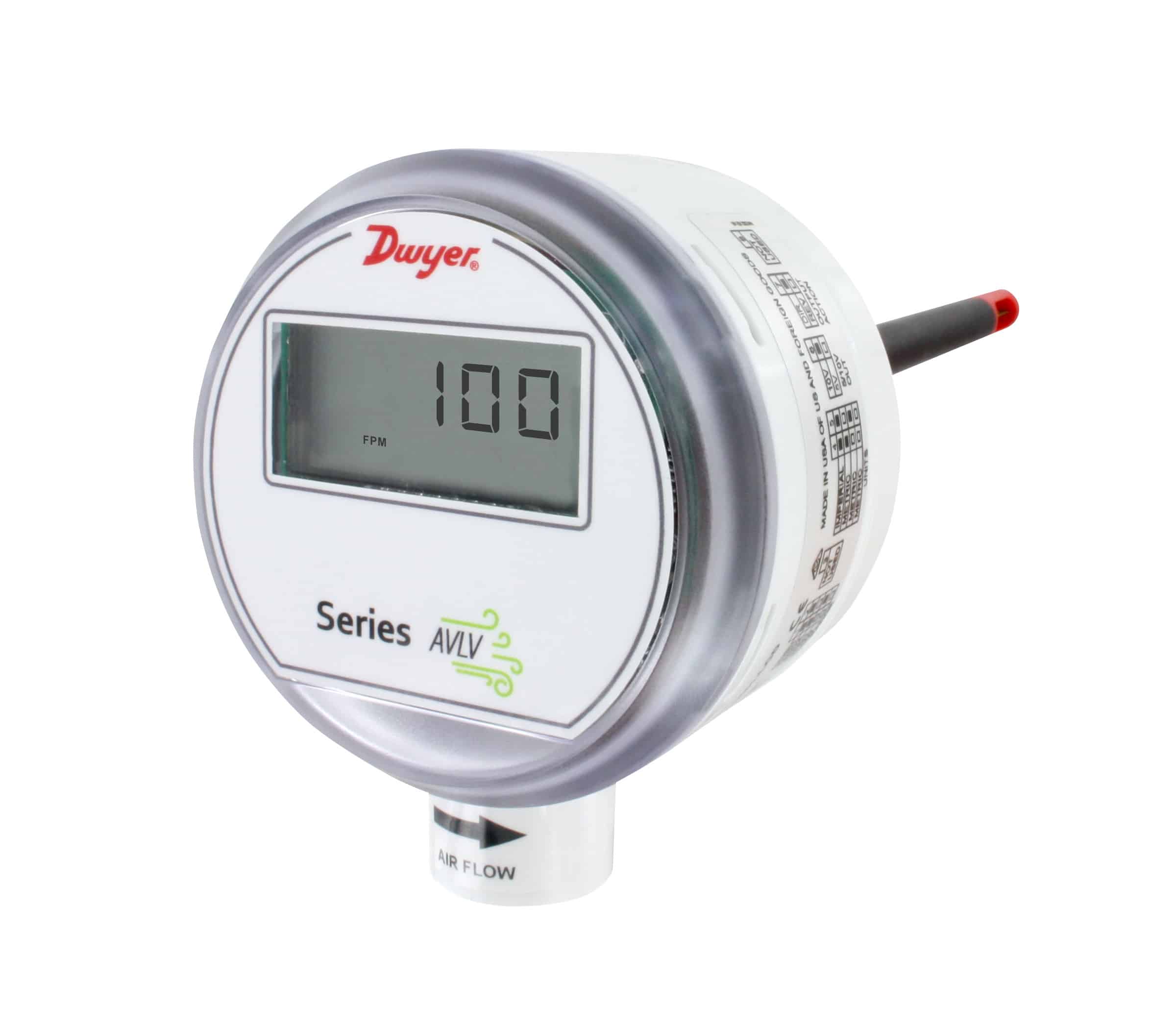
Dwyer Instruments offers a multitude of sensors for monitoring air velocity in HVAC systems. Some of this instrumentation has a simple construction (Pitot tubes, for example) while others are more complex, such as hot-wire anemometers. The initial term and first “hot-wire anemometer” was developed back in 1914 by Louie Vesso King. He is also accredited...
Explore now
From dairy to petrochemicals, several applications require monitoring or control of liquids in tanks. Wastewater facilities are among the many industries requiring meticulous observation. The technology used for this measurement is dependent upon the type of tank and its contents. Capacitive level switches, for example, detect level and send a switch signal output when the...
Explore now

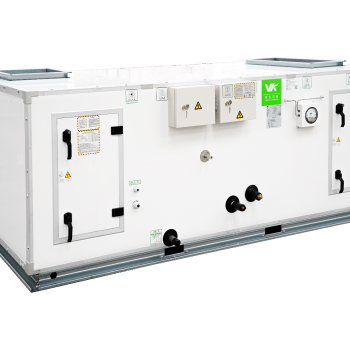 The Modular AHU (VAC series) is engineered to serve environments with stringent requirements for air quality, temperature, and humidity control. Thanks to its flexible modular design, cross-contamination prevention, microbial growth inhibition, and superior thermal insulation performance, the product is ideal for a wide range of diverse applications.
VECK - MODULAR AIR HANDLING UNIT (AHU) - VAC
Explore now
The Modular AHU (VAC series) is engineered to serve environments with stringent requirements for air quality, temperature, and humidity control. Thanks to its flexible modular design, cross-contamination prevention, microbial growth inhibition, and superior thermal insulation performance, the product is ideal for a wide range of diverse applications.
VECK - MODULAR AIR HANDLING UNIT (AHU) - VAC
Explore now
 The VECK VASW Series is a premier air-cooled screw chiller solution, specifically engineered for large-scale central air conditioning systems. By perfectly integrating advanced screw compressor technology with an intelligent control system, VECK is committed to delivering superior cooling efficiency across all weather conditions.
VECK - AIR-COOLED SCREW CHILLER - VASW
Explore now
The VECK VASW Series is a premier air-cooled screw chiller solution, specifically engineered for large-scale central air conditioning systems. By perfectly integrating advanced screw compressor technology with an intelligent control system, VECK is committed to delivering superior cooling efficiency across all weather conditions.
VECK - AIR-COOLED SCREW CHILLER - VASW
Explore now
 The VECK FCU Series is a premium line of Fan Coil Units featuring cutting-edge BLDC motor technology from China. Designed as an optimal solution, it delivers refreshing airflow, ultra-quiet operation, and exceptional energy efficiency. It is the perfect choice for central air conditioning systems in office buildings, hotels, and modern commercial projects.
VECK - FAN COIL UNIT (FCU)
Explore now
The VECK FCU Series is a premium line of Fan Coil Units featuring cutting-edge BLDC motor technology from China. Designed as an optimal solution, it delivers refreshing airflow, ultra-quiet operation, and exceptional energy efficiency. It is the perfect choice for central air conditioning systems in office buildings, hotels, and modern commercial projects.
VECK - FAN COIL UNIT (FCU)
Explore now
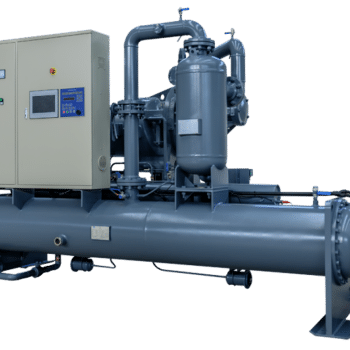 The Ebara RHSCW Series is a water-cooled screw chiller line featuring Japan's leading twin-screw compression technology. It is an optimal solution designed to provide a stable chilled water supply for central air-conditioning systems and large-scale industrial cooling processes.
EBARA-HIGH EFFICIENCY SCREW CHILLER-RHSCW
Explore now
The Ebara RHSCW Series is a water-cooled screw chiller line featuring Japan's leading twin-screw compression technology. It is an optimal solution designed to provide a stable chilled water supply for central air-conditioning systems and large-scale industrial cooling processes.
EBARA-HIGH EFFICIENCY SCREW CHILLER-RHSCW
Explore now